

Columbia Suboxone Clinic Blog
Maury County, Tennessee Identified as a High-Impact Area in DEA Pain Pill Distribution Data
Maury County, Tennessee has been deeply affected by the opioid crisis—and the data confirms what many local families in Columbia, Tennessee and surrounding communities have experienced firsthand.
According to historical data from the DEA’s Prescription Pain Pill Database, Maury County ranked in the “higher than normal” category for prescription opioid distribution during the peak years of the opioid epidemic. While these numbers date back several years, they provide crucial insight into how opioid addiction took hold in Maury County, TN, and why its effects are still felt today across Columbia, Mount Pleasant, Culleoka, and nearby rural areas.
This article examines what the DEA data revealed about Maury County, how prescription pain pills contributed to widespread opioid dependence, and why understanding this history is essential for recovery-focused communities like Columbia, Tennessee.
What the DEA Pain Pill Database Revealed
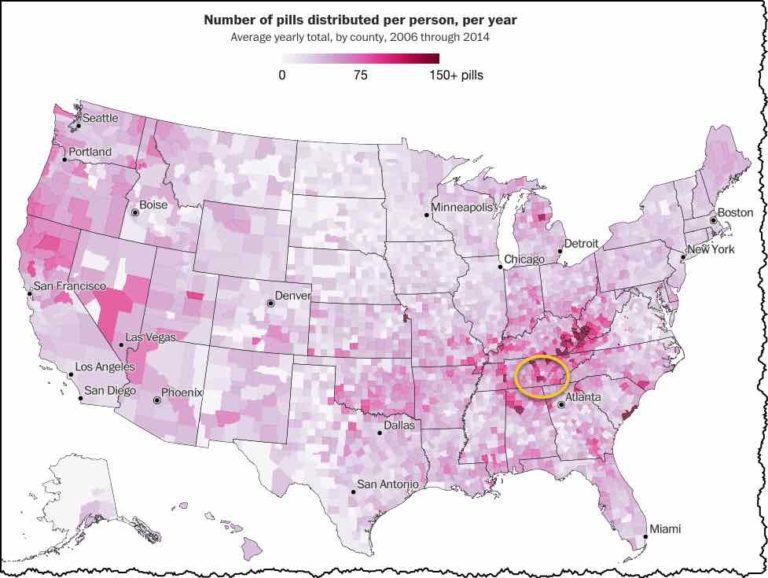
In a widely cited investigative series, The Washington Post analyzed confidential DEA data tracking the distribution of prescription opioid pain pills across the United States. The database documented how many pills were shipped to individual counties, pharmacies, and distributors between 2006 and 2014, a period many experts consider the height of prescription opioid overuse.
The report included an interactive map that allowed readers to examine opioid distribution levels at the county level. When researchers reviewed the data for Maury County, Tennessee, the findings were staggering—especially given the county’s modest population size.
Tennessee’s Prescription Opioid Crisis: The Statewide Context
To understand the scope of the problem in Maury County, it’s important to first look at the larger picture across Tennessee.
Between 2006 and 2014, more than 3.3 billion prescription pain pills were supplied statewide. That number alone highlights how deeply opioid medications were embedded into everyday medical care throughout Tennessee during that era.
Some key statewide figures include:
- 3,315,502,327 prescription opioid pills supplied to Tennessee
- 607,686,440 pills distributed by AmerisourceBergen Drug
- 1,369,976,173 pills manufactured by Actavis Pharma, Inc.
- One of the highest-volume receiving pharmacies during this period was located in Murfreesboro, Tennessee
These pills were not limited to large cities. Rural and mid-sized counties—like Maury County, TN—received quantities that far exceeded what many would consider medically reasonable.
Prescription Pain Pills in Maury County, Tennessee
When the DEA data is narrowed specifically to Maury County, the scale becomes even more alarming.
From 2006 to 2014, a total of 43,130,250 prescription pain pills were supplied to Maury County, Tennessee. Based on population figures during that time, this amounted to approximately 60 pills per person per year—every year, for nearly a decade.
For residents of Columbia, Tennessee, this data confirms what many observed locally: opioid medications were widely available, routinely prescribed, and often underestimated in terms of addiction risk.
Additional details from the database show:
- 9,434,080 pills were distributed by AmerisourceBergen Drug
- 20,617,900 pills were manufactured by Actavis Pharma, Inc.
These numbers reflect legal pharmaceutical distribution—not illicit drug trafficking—underscoring how prescription practices contributed to opioid dependency throughout Maury County.
How Prescription Opioids Impacted Columbia, Tennessee
As the county seat and largest city in Maury County, Columbia, Tennessee experienced the effects of prescription opioid saturation more visibly than most areas.
Many individuals in Columbia were first exposed to opioids through legitimate medical prescriptions—often following injuries, surgeries, or chronic pain conditions. Over time, tolerance developed, prescriptions escalated, and dependency followed.
When prescribing guidelines eventually tightened and pill supplies decreased, many people in Columbia and greater Maury County found themselves physically dependent without access to the medications their bodies had grown accustomed to. This shift played a significant role in the rise of illicit opioid use, including heroin and fentanyl.
The transition from prescription opioids to street drugs is now a well-documented pattern nationwide—and Maury County, Tennessee was no exception.
Why This Data Still Matters Today
Although the DEA pain pill data ends in 2014, its relevance remains extremely high for communities like Columbia, TN.
Addiction does not disappear when prescribing rules change. The neurological and behavioral impacts of opioid dependence often persist for years, sometimes decades. Many individuals currently seeking treatment in Maury County trace their addiction back to prescriptions received during this exact time period.
Understanding this history helps reduce stigma. Opioid addiction in Maury County, Tennessee was not caused by moral failure—it was fueled by systemic overprescribing, aggressive pharmaceutical distribution, and limited early education about addiction risks.
Recovery and Treatment in Maury County, Tennessee
Today, Maury County is no longer just a data point in a federal database—it is a community actively working toward recovery.
Recovery Care of Columbia provides evidence-based treatment for opioid use disorder to residents throughout Columbia, Tennessee and the surrounding areas of Maury County. As a locally rooted clinic, Recovery Care of Columbia understands the unique challenges faced by individuals and families impacted by opioid addiction in this region.
Medication-assisted treatment (MAT), including Suboxone, combined with counseling and accountability, has helped many Maury County residents regain stability, rebuild relationships, and return to productive lives.
A Continuing Commitment to Transparency and Education
This article represents Part 1 of an ongoing series examining opioid addiction trends, treatment access, and recovery outcomes in Maury County, Tennessee.
By continuing to analyze historical data and present-day realities, Recovery Care of Columbia aims to educate the public, reduce misinformation, and encourage individuals in Columbia, TN and nearby communities to seek help without shame or fear.
If you live in Maury County and have information, insight, or personal experience that could help educate others about opioid addiction or recovery, we invite you to reach out via email at [email protected].
Moving Forward as a Maury County Community
The DEA pain pill database revealed a difficult truth about Maury County, Tennessee—but it also provides an opportunity for understanding, accountability, and healing.
By acknowledging the past and supporting accessible, compassionate treatment today, communities like Columbia, Tennessee can continue moving forward—stronger, better informed, and committed to recovery.
Telemedicine Addiction Treatment in Maury County, TN, Accepting Medicaid, Private Insurance, and Self-Pay
- Register for virtual Suboxone treatment in Maury County, Tennessee
- Register for online Suboxone therapy in Maury County, Tennessee using private health insurance
- Schedule Self-Pay virtual Suboxone treatment in Maury County, Tennessee
- Returning patient? Click here to register
- Maury County, TN Sliding-Scale Program for Addiction Treatment
- View all insurance plans we accept
- View our affordable self-pay program with biweekly and monthly payments
- We accept all TennCare Medicaid insurance plans, including Amerigroup Community Care, BlueCare, United Healthcare Community Plan, and Wellpoint Community Care
- We accept all major private insurance plans (from your employer or Healthcare.gov) including BCBS, Cigna, Ambetter, and United Healthcare.
Not sure if your insurance covers treatment? Click here to check your insurance coverage now.
Experience a safe transition from hydrocodone, oxycodone, OxyContin, heroin, fentanyl, methadone, morphine, Kratom, 7-OH (7-Hydroxy-opioids), Tramadol, Opana, codeine, oxymorphone, Percocet, and other opioids.
Call or text us at (931) 548-3062 to speak to someone about our telemedicine Suboxone program. You can also message us securely on the Spruce Health mobile app.