

Columbia Suboxone Clinic Blog
Kratom Ban Tennessee 2026: What Users Need to Do Before July 1
If you’ve been using kratom — including 7-OH or 7-hydroxymitragynine products — you already know what it feels like when that supply disappears. The kratom ban Tennessee 2026 is no longer a rumor. It’s real, it’s coming fast, and July 1 is the hard deadline every kratom user in Tennessee needs to mark on their calendar. Here’s what the ban actually means, what happens to your body when kratom is suddenly gone, and — most importantly — how to protect yourself with a safer, medically supervised path forward.
What Is the Tennessee Kratom Ban and When Does It Take Effect?
Tennessee’s HB 1649, known as Matthew Davenport’s Law, passed the House in an overwhelming 78-9 vote and cleared the Senate 23-3 before heading to Governor Bill Lee’s desk for signature. Named after 27-year-old Chattanooga resident Matthew Davenport, who died in 2024 following a lethal interaction between kratom and prescription medications, the law classifies all forms of kratom — including natural kratom powder and concentrated 7-OH (7-hydroxymitragynine) extracts — as controlled substances under Tennessee law.
The key dates and penalties:
- Effective Date: July 1, 2026
- Possession: Class A misdemeanor
- Sale or Distribution: Felony offense
- Toxicology Testing: Required in suspected overdose cases to detect kratom
This means that after July 1, buying kratom at a gas station, smoke shop, or vape store in cities like Knoxville, Murfreesboro, Johnson City, Clarksville, or Jackson will be a criminal act — not just for the seller, but potentially for the buyer.
Understanding the Kratom Withdrawal Timeline in Tennessee
Why the Kratom Ban Tennessee 2026 Is Different From What You’ve Heard Before
Kratom has survived previous scheduling attempts. The DEA once moved to classify it as a Schedule I substance but backed off. But this time, Tennessee isn’t waiting for federal action. The state legislature has moved decisively, and with bipartisan support in both chambers, the kratom ban in Tennessee is almost certain to become law before the July 1 deadline.
What makes this ban particularly significant for users:
- 7-OH products are included. High-potency kratom extracts — often sold as gummies, shots, or capsules and sometimes described as being up to 13 times more potent than morphine — are explicitly covered.
- There’s no grace period. The ban takes effect fully on July 1, with no phase-out for existing stock.
- Criminal penalties apply to users. Unlike some regulatory approaches, this bill creates misdemeanor-level consequences for possession.
For the estimated hundreds of thousands of kratom users in Tennessee, this isn’t just a policy change — it’s a supply emergency.
The Real Risk: Kratom Withdrawal Is Not “Just Stopping a Supplement”
Here’s what many kratom users don’t talk about openly: kratom is physically addictive, and stopping it — especially if you’ve been using it daily for months or years — causes real, painful withdrawal.
What Kratom Withdrawal Actually Feels Like
Kratom’s active compounds, mitragynine and 7-hydroxymitragynine, act on the same opioid receptors in your brain as heroin, oxycodone, fentanyl, and Percocet. When those receptors are suddenly starved of kratom, your body reacts:
- Muscle aches and body pain
- Nausea, vomiting, and diarrhea
- Sweating and chills
- Severe anxiety and restlessness
- Insomnia for days
- Intense cravings
- Depression and irritability
If you’ve been using high-dose kratom or concentrated 7-OH products, your withdrawal experience may be similar in intensity to opioid withdrawal. And when July 1 hits and product disappears from shelves overnight, there will be no warning. No slow taper. Just gone.
That’s why you need to act now, not June 30.
Kratom and 7-OH Addiction Treatment in Tennessee
Does Suboxone Work for Kratom Withdrawal? Yes — and Here’s Why
One of the most important things kratom users in Tennessee can learn right now: Suboxone (buprenorphine/naloxone) works for kratom withdrawal — and it works well.
Because kratom binds to the same opioid receptors as traditional opioids, it responds to the same FDA-approved medications used in opioid addiction treatment. Multiple peer-reviewed case studies and clinical reports have documented successful transition from kratom dependence to Suboxone, including patients who had been using kratom daily for years.
Here’s how it works:
- Buprenorphine (the active ingredient in Suboxone) occupies opioid receptors in your brain, stopping withdrawal symptoms and cravings
- Naloxone (added to Suboxone) deters misuse
- Patients are typically started on 4–16 mg per day, adjusted based on their usage levels
- Most patients report significant relief from withdrawal symptoms within hours of their first dose
A study published in the Journal of Addiction Medicine found that patients using kratom at higher doses typically stabilized successfully on daily doses of Suboxone between 12 and 16 mg — the same therapeutic range used for opioid use disorder.
Recovery Care of Columbia Offers Suboxone Treatment for the Kratom Ban Tennessee 2026 Transition
If you’re in Tennessee and you’re dependent on kratom, you don’t have to wait for withdrawal to hit on July 1 with nowhere to turn. Recovery Care of Columbia — Tennessee’s first licensed provider of virtual addiction treatment — is already helping kratom users transition safely to Suboxone before the ban goes into effect.
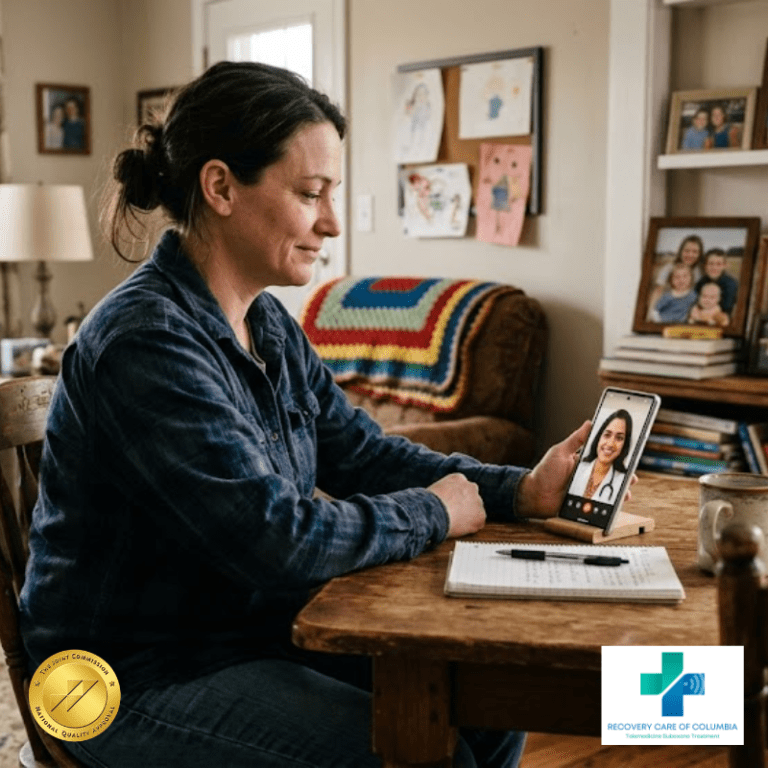
No clinic. No waiting room. No driving across the county. Everything is done through your phone or computer.
How to Start Suboxone Treatment Virtually at Recovery Care of Columbia
Virtual Addiction Treatment: Why It’s the Right Answer for Tennessee’s Kratom Users
Most people who are dependent on kratom in Tennessee face barriers that make traditional treatment feel impossible:
- Live in a rural area with no nearby clinic
- Don’t have reliable transportation
- Work odd hours and can’t take time off
- Don’t want coworkers, family, or neighbors knowing
- Worried about the cost of treatment
- Have prior legal issues that make walking into a clinic intimidating
Recovery Care of Columbia was built specifically for people like you.
As Tennessee’s first and only clinic with a medical license for fully virtual addiction treatment, Recovery Care of Columbia removes every one of those barriers:
- 100% telemedicine — appointments by phone or video from wherever you are
- Medication delivered to your door — Suboxone can be sent directly to your home (delivery fee applies), so you never have to visit a pharmacy
- TennCare Medicaid accepted — for qualifying patients, treatment costs are $0
- Commercial insurance accepted
- Flexible payment plans available for uninsured patients
- Licensed Tennessee providers — real doctors and medical professionals, not a chatbot
Whether you’re in a small town outside of Clarksville, or Cumberland City, Chattanooga, Cleveland, Dayton, Decatur, East Ridge, or anywhere between Murfreesboro and Jackson, you can start treatment today from your phone.
What You Should Do Right Now — Before July 1
The kratom ban Tennessee 2026 is creating a real public health window. Users who act now can make a smooth, medically supervised transition. Users who wait may face forced, cold-turkey withdrawal after July 1 with no support.
Here’s your action plan:
- Don’t wait. July 1 will come faster than you think. The process of starting treatment is quick — often same-day.
- Don’t go cold turkey. Suddenly stopping kratom, especially high-potency 7-OH products, can cause severe withdrawal. Never quit cold turkey without medical supervision.
- Call or text Recovery Care of Columbia to ask about your options. There’s no judgment — just information and help.
- Find out if your insurance covers treatment. TennCare Medicaid often covers treatment at $0. Commercial plans frequently cover it too.
- Ask about home delivery of your Suboxone medication so you never have to visit a pharmacy.
📞 Call or Text Recovery Care of Columbia: (931) 548-3062
Frequently Asked Questions About the Kratom Ban Tennessee 2026
1. Is the kratom ban in Tennessee definitely happening on July 1, 2026?
The bill has passed both the Tennessee House (78-9) and Senate (23-3) and is awaiting Governor Bill Lee’s signature. Given the overwhelming bipartisan support, the law is widely expected to be signed and take effect July 1, 2026. Even if there are last-minute legislative changes, the direction is clear: kratom’s days as a legal substance in Tennessee are numbered. Don’t wait to make a plan.
2. Is 7-OH (7-hydroxymitragynine) included in the ban?
Yes. The Tennessee kratom ban explicitly covers all forms of kratom, including synthetic and concentrated forms like 7-OH and 7-hydroxymitragynine. These high-potency extracts — often sold as gummies, drops, and capsules at gas stations and vape shops — are fully covered under HB 1649. Using or possessing any of these products after July 1 will be a criminal offense.
3. What happens if I’m physically dependent on kratom and I just stop?
Stopping kratom suddenly — especially if you’ve been using it daily or using high-potency 7-OH products — can trigger serious withdrawal symptoms including muscle pain, severe nausea, anxiety, insomnia, diarrhea, sweating, and intense cravings. This is not like quitting coffee. Kratom binds to the same receptors as opioids like oxycodone and heroin, and withdrawal can be genuinely debilitating. Please do not attempt to stop without medical support.
4. Can Suboxone really help with kratom and 7-OH withdrawal?
Yes. Because kratom’s active compounds (mitragynine and 7-hydroxymitragynine) interact with opioid receptors just like traditional opioids do, the same FDA-approved treatment — Suboxone (buprenorphine/naloxone) — has been shown in multiple clinical case reports to effectively manage kratom withdrawal and cravings. Patients in published studies report significant symptom relief within hours to days of starting Suboxone treatment.
5. Do I have to go to a clinic to get Suboxone treatment?
Not at Recovery Care of Columbia. As Tennessee’s first licensed virtual addiction treatment provider, we conduct all appointments by phone or video. Your prescription can be sent to a local pharmacy or delivered directly to your home (delivery fee applies). You’ll never need to set foot in a clinic or waiting room.
6. Will my TennCare Medicaid cover Suboxone treatment?
In most cases, yes. TennCare Medicaid typically covers Suboxone treatment in full for qualifying patients, meaning your cost could be $0 for both appointments and medication. If you have commercial health insurance, we’ll provide a cost estimate before your first appointment. Uninsured patients can access affordable payment plans, including sliding-scale options.
7. I’m worried about being judged or reported. Is treatment confidential?
Absolutely. Medical confidentiality laws — including HIPAA — protect your treatment information. Your provider cannot share your participation in addiction treatment with your employer, family, law enforcement, or anyone else without your permission. Recovery Care of Columbia was co-founded by people in active recovery. There is zero judgment here — only compassion and real help.
8. I’ve been using kratom to manage pain ever since I hurt my back / had surgery. Am I addicted?
You may be physically dependent on kratom, whether or not you identify as “addicted.” If you need kratom daily to feel normal, or if you experience discomfort when you don’t take it on schedule, your body is physically dependent — and that’s a medical issue, not a moral failure. After July 1, kratom won’t be available. Suboxone can manage the same pain and withdrawal signals while putting you in a supervised, legal, and stable treatment program. Many patients discover they feel significantly better on Suboxone than they ever did managing their symptoms with kratom.
9. I’ve been through legal trouble before. Can I still get treatment?
Yes. Having a prior criminal record does not disqualify you from addiction treatment, and Recovery Care of Columbia does not discriminate based on legal history. In fact, our virtual model means you don’t have to worry about being seen entering a clinic — everything is done from your own home, on your own device. Your past does not define your access to care.
10. What if I want to help a family member or friend who’s dependent on kratom?
You’ve come to the right place. Many patients at Recovery Care of Columbia are referred by a concerned family member or friend — a spouse, a parent, a sibling. You can call on their behalf to learn about options. We’ll walk you through how the process works, what to say, and how to help someone take that first step. Recovery starts with someone who cares enough to reach out.
💡Learn exactly how to transition from kratom to Suboxone in Tennessee
You Don’t Have to Face July 1 Alone
The kratom ban Tennessee 2026 is a wake-up call — and for thousands of Tennesseans, it may also be the push toward something better. If you’ve been telling yourself you’ll deal with this later, later is now.
Recovery Care of Columbia has helped more than a thousand Tennessee patients transition from kratom, heroin, fentanyl, oxycodone, OxyContin, Percocet, and other opioids into stable, lasting recovery — without ever visiting a clinic. We know what withdrawal feels like. We know what it’s like to be afraid and uncertain. We built this program because we’ve been where you are.
One phone call or text is all it takes to get started.
📞 Call or Text: (931) 548-3062 🌐 Register online 💬 Message us on the Spruce Health app — private and secure
You deserve a life that isn’t ruled by Kratom/7-Hydroxy or pill-chasing. Let’s build it together — before July 1.
Recovery Care of Columbia is Tennessee’s first licensed virtual addiction treatment provider. We accept TennCare Medicaid, commercial insurance, and offer flexible payment plans. All treatment is 100% telemedicine. Medication can be delivered to your door.