



Columbia Suboxone Clinic Blog

How to Take Suboxone Film Correctly
Place the whole Suboxone film under your tongue or against the inside of your cheek, as directed by your prescriber, and leave it in place until it dissolves completely. While it dissolves, avoid eating, drinking, chewing, swallowing the film, or moving it around.
Quick Facts
- Under the tongue is called sublingual. Inside the cheek is called buccal. Follow the placement instructions for the specific film you were prescribed.
- Let the film dissolve fully. Use complete dissolving as your cue to move on.
- Protect your teeth afterward. Gently rinse around your teeth and gums with water, swallow the rinse, and wait at least one hour before brushing.
- If you accidentally swallow the film or it falls out, ask your pharmacist or prescriber what to do before taking another film.
What Is Suboxone Film, and How Does It Work?
Suboxone film is a prescription medication used to treat opioid use disorder. It contains two active ingredients:
- Buprenorphine: A partial opioid agonist that helps reduce opioid withdrawal symptoms and cravings.
- Naloxone: An opioid antagonist included primarily to discourage misuse through certain routes of administration, such as injection.
When taken as prescribed, buprenorphine acts on opioid receptors in the brain, helping stabilize symptoms associated with opioid dependence.
Suboxone film is designed for absorption through the lining of the mouth rather than through the digestive system.
Brand-name Suboxone film has two approved administration methods:
- Sublingual administration: Placing the film under the tongue.
- Buccal administration: Placing the film against the inside of the cheek.
The manufacturer’s instructions specify sublingual administration when starting treatment. Buccal administration may be used after the first few days, according to your prescriber’s instructions.
Both methods allow medication to pass through the oral tissues into the bloodstream.
Your healthcare provider should explain which method to use and how much medication to take. Don’t switch administration methods without discussing the change with your prescriber.
If you’re new to medication-assisted treatment, RCC’s guide to online Suboxone treatment in Tennessee explains how virtual treatment and ongoing medication management work.
How to Take Suboxone Film Under Your Tongue: Step-by-Step Instructions
Taking Suboxone film under the tongue is called sublingual administration.
The following steps reflect the manufacturer’s instructions for brand-name Suboxone sublingual film. Follow the specific instructions provided with your prescription, particularly if you receive a different formulation.
- Prepare Your Mouth
- Before taking Suboxone film, drink some water to moisten your mouth. A moist mouth helps the film dissolve more easily.
- Check your prescription to confirm the correct dose. Make sure you have the correct medication and film strength.
- Wait until you’re ready to take your medication before opening the pouch.
- Choose a comfortable place where you can remain still while the film dissolves.
- Open the Film Pouch
- Carefully open the sealed foil pouch using the manufacturer’s instructions.
- Remove the film and hold it between your fingers by its outside edges.
- The manufacturer’s instructions specify administering the film whole. Be sure to ask your provider before cutting or tearing films into smaller pieces.
- If you have difficulty opening the packaging, ask your pharmacist to demonstrate the correct method.
- Avoid opening several pouches in advance–each film comes in protective packaging designed to keep it secure until use.
- Place the Film Under Your Tongue
- Lift your tongue and place the film underneath it, near the base of your tongue.
- Position the film slightly to the left or right of the center.
- The film should rest against the tissue beneath your tongue.
- Keep it in its original position.
- Avoid touching or adjusting it.
- Don’t move it around your mouth.
- Allow it to dissolve naturally.
- You don’t need to press the film repeatedly against your tongue.
- Let the Film Dissolve Completely
- Keep the film under your tongue until it has fully dissolved.
- Don’t chew the film.
- Don’t swallow the film as a whole.
- Avoid talking.
- Don’t eat or drink.
- Avoid moving the film with your tongue to help with absorption.
- The film gradually dissolves, allowing medication to be absorbed through the lining of your mouth.
- You can swallow your saliva normally, but avoid deliberately swallowing an undissolved piece of film.
- Follow the Recommended Oral Care Instructions
- After the film has completely dissolved, take a sip of water, gently swish it around your teeth and gums, and swallow.
- Wait at least one hour before brushing your teeth.
These precautions matter because medications containing buprenorphine that dissolve in the mouth have been associated with dental problems, including cavities and tooth damage.
The FDA’s buprenorphine dental safety recommendations explain these risks and the recommended precautions.
Continue taking your medication as prescribed, even if you’re concerned about dental health. Discuss prevention strategies with your healthcare provider and dentist.
Can You Put Suboxone Film Inside Your Cheek Instead?
Yes. Brand-name Suboxone sublingual film is approved for both sublingual and buccal administration.
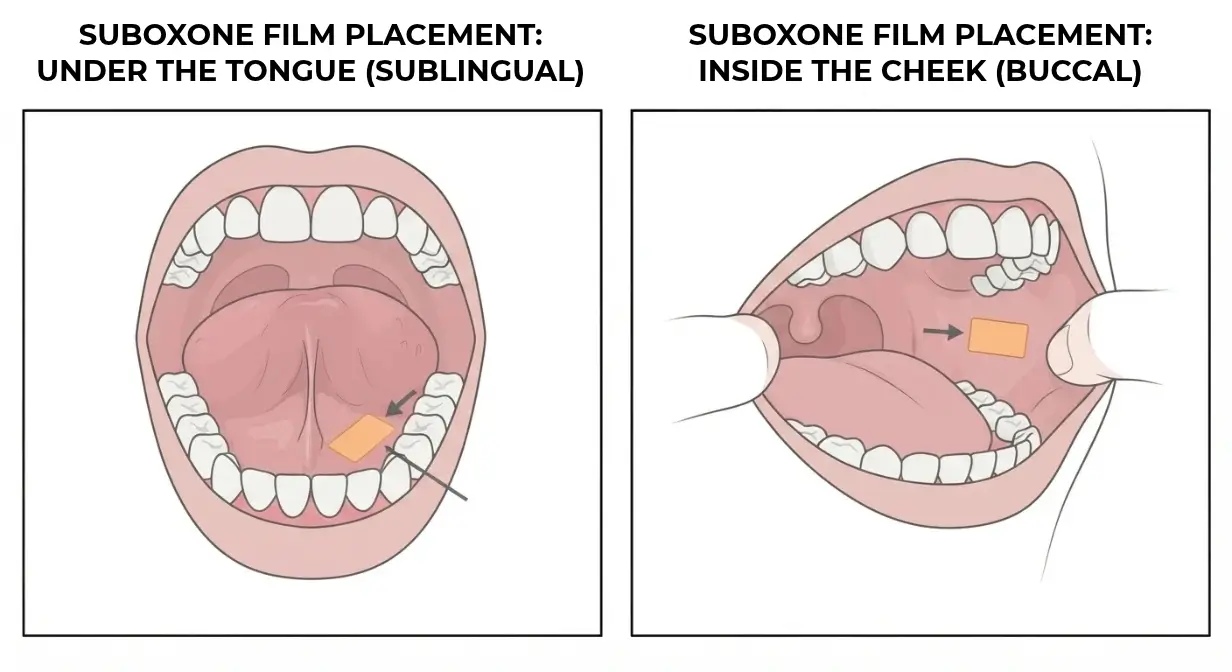
Sublingual and Buccal placement for Suboxone Films
Buccal administration means placing the film against the inside lining of your cheek.
However, the manufacturer’s instructions specify taking Suboxone under the tongue when starting treatment. After the first few days, buccal administration may be used.
If your healthcare provider has directed you to use this method:
- Moisten your mouth with water before administration.
- Remove the film from its protective pouch.
- Place one film against the inside of your right or left cheek.
- Leave it in place until it completely dissolves.
- Avoid eating, drinking, chewing, or moving the film while it dissolves.
For two prescribed films taken simultaneously, the manufacturer’s instructions direct placement on opposite cheeks.
If a third film is prescribed, wait until the first two films have dissolved before placing the third film.
Is Suboxone More Effective Under the Tongue or Inside the Cheek?
Both administration methods are approved, but medication absorption can vary depending on placement.
The manufacturer’s prescribing information recommends using the same administration method consistently.
Changing from under-the-tongue placement to inside-the-cheek placement may alter medication exposure.
Therefore, use the method recommended by your prescriber rather than switching based on convenience.
How Long Does Suboxone Film Take to Dissolve?
Suboxone film usually dissolves over several minutes, but the exact time varies.
Factors that may affect dissolving time include:
- How moist your mouth is.
- Where the film is placed.
- Whether the film remains undisturbed.
- Individual differences in saliva production.
There’s no need to rush the process.
The most important instruction is to let the film dissolve completely, even if it takes longer than expected.
Don’t use a fixed number of minutes as permission to swallow or remove medication that hasn’t finished dissolving.
What If Suboxone Film Is Taking Too Long to Dissolve?
If your film takes longer than expected, avoid chewing it, moving it around, or drinking water while it remains in your mouth.
Instead, continue allowing the medication to dissolve naturally.
For future doses, moistening your mouth before administration may help.
If the film repeatedly fails to dissolve properly or you experience significant dry mouth, speak with your pharmacist or healthcare provider.
Don’t take an additional film because the first one dissolved slowly.
Common Mistakes When Taking Suboxone Film
Incorrect administration can change how much medication your body absorbs.
Understanding common mistakes can help you follow your treatment plan more consistently.
1. Swallowing the Film Instead of Letting It Dissolve
Swallowing an intact Suboxone film isn’t the intended administration method.
Buprenorphine has lower oral bioavailability when swallowed because the digestive system and liver process much of the medication before it reaches circulation.
As a result, swallowing the film may reduce its intended effect.
If you accidentally swallow your film before it dissolves, contact your healthcare provider or pharmacist for advice.
Don’t automatically repeat the dose. Some medication may already have been absorbed, and taking more without guidance could be unsafe.
2. Chewing or Breaking the Film
Brand-name Suboxone film shouldn’t be chewed, cut, or torn.
Changing the film’s form can interfere with proper administration.
If your prescribed dose seems difficult to manage with the available film strengths, ask your prescriber about appropriate dosing options.
3. Eating or Drinking Before the Film Dissolves
Food and beverages can interfere with proper film placement while the medication is dissolving.
Don’t eat or drink until the film has completely dissolved.
Afterward, follow the recommended water-rinsing instructions.
4. Talking While the Film Is Dissolving
Talking can move the film or interfere with contact between the medication and the oral tissues.
Try to remain quiet until the film has dissolved completely.
If you need to speak during administration, avoid moving the film as much as possible.
5. Moving the Film Around Your Mouth
The film should remain in the same location after placement.
Moving it from one side of your mouth to another may affect consistent absorption.
If the film becomes displaced or accidentally comes out of your mouth, contact your healthcare provider or pharmacist rather than guessing whether to replace the dose.
6. Taking More Than the Prescribed Dose
Taking additional Suboxone film without medical guidance can increase the risk of side effects, including sedation and breathing problems.
Never take extra medication to compensate for a dose that seems slow to dissolve or doesn’t appear to work immediately.
Your healthcare provider can evaluate whether your current dose is appropriate.
7. Changing Administration Methods Without Guidance
Switching between sublingual and buccal administration may change medication absorption.
Follow your prescribed administration method consistently.
8. Ignoring Dental Care
Buprenorphine medications that dissolve inside the mouth have been associated with dental problems, even among patients without a previous history of dental disease.
Follow the water-rinsing instructions after each dose, wait at least one hour before brushing, and attend regular dental appointments.
Dental concerns should be addressed without abruptly discontinuing treatment.
What Should You Do If You Take Suboxone Film Incorrectly?
Mistakes sometimes happen, particularly when someone is unfamiliar with medication that dissolves inside the mouth.
The appropriate response depends on what happened.
If You Accidentally Swallow the Film
Don’t immediately take another dose.
Some medication may have been absorbed before you swallowed the remaining film.
Contact your healthcare provider or pharmacist and explain what happened. They can advise whether any additional action is necessary.
If the Film Falls Out of Your Mouth
If the film comes out before fully dissolving, don’t automatically replace it with another film.
The amount already absorbed may be difficult to determine.
Contact your healthcare provider for guidance.
If You Accidentally Take an Extra Film
Taking more Suboxone than prescribed can cause serious side effects.
Contact Poison Control or seek emergency medical assistance if you’ve taken too much. In the United States, Poison Control can be reached at 1-800-222-1222.
If someone has slow or difficult breathing, cannot be awakened, or loses consciousness, call 911 immediately. Administer naloxone if available and follow emergency instructions.
If You Miss a Dose
Always contact your prescriber when you have a question regarding dosage.
If your next dose is approaching, skip the missed dose and return to your normal schedule.
Don’t take two doses simultaneously unless your healthcare provider specifically instructs you to do so.
How to Take More Than One Suboxone Film
Some patients receive prescriptions that require more than one film to reach the recommended dose.
The correct method depends on the number of films and the prescribed administration route.
Taking Two Films Under the Tongue
If your prescriber instructs you to take two films at the same time:
- Place the first film beneath your tongue on one side.
- Place the second film beneath your tongue on the opposite side.
- Avoid allowing the films to overlap or touch.
- Keep both films in place until they dissolve completely.
Taking Three Films
For three films, the manufacturer’s instructions direct patients to place the third film after the first two films have dissolved.
The third film should be placed using the prescribed administration method.
Don’t place all three films in your mouth simultaneously unless your healthcare provider gives instructions supported by the specific product you’re using.
Why Following Your Prescribed Dose Matters
Suboxone doses are individualized according to the patient’s symptoms, treatment response, medical history, and other medications.
Taking more or less than prescribed may affect treatment.
If you continue experiencing opioid cravings or withdrawal symptoms, discuss them with your healthcare provider instead of changing the dose independently.
RCC’s online Suboxone treatment program provides ongoing medication management for eligible patients throughout Tennessee.
When Should You Take Suboxone Film?
Your healthcare provider determines when you should take Suboxone and how frequently you need it.
During maintenance treatment, many patients take their prescribed medication once daily. However, treatment schedules can differ based on individual needs.
Taking the medication consistently according to your prescription can help maintain stable buprenorphine exposure.
Starting Suboxone Treatment for the First Time
The timing of your first Suboxone dose is especially important.
Starting buprenorphine too soon after using certain opioids can cause precipitated withdrawal, a rapid onset or worsening of withdrawal symptoms.
The appropriate timing depends on the opioid involved, the severity of withdrawal, and the treatment protocol.
Fentanyl exposure can make starting buprenorphine more complicated because the time course of withdrawal may be unpredictable.
A healthcare provider may recommend a standard induction approach or a different medically supervised strategy.
For more information, read RCC’s guide to understanding and avoiding precipitated withdrawal.
Don’t attempt to determine your first dose or induction timing alone. Contact your prescriber for instructions.
Should You Take Suboxone Before or After Eating?
You may find it easier to take Suboxone when you can comfortably avoid food and beverages during the dissolving process.
The key requirement is not to eat or drink while the film is dissolving.
Once the film has fully dissolved, follow the recommended oral-rinsing procedure.
Your healthcare provider can offer additional guidance if nausea, dry mouth, or other symptoms make administration difficult.
Suboxone Film Side Effects and Safety Precautions
Like other prescription medications, Suboxone can cause side effects.
Commonly reported side effects include:
- Headache
- Nausea or vomiting
- Constipation
- Sweating
- Difficulty sleeping
- Mouth numbness or irritation
- Dizziness or lightheadedness
Some symptoms may improve as treatment continues, while others require medical assessment.
Don’t assume every symptom is a medication side effect. New or worsening symptoms should be discussed with your healthcare provider.
Avoid Combining Suboxone With Alcohol or Sedating Drugs
Combining Suboxone with alcohol, benzodiazepines, other opioids, or other medications that depress the central nervous system can increase the risk of dangerous sedation and respiratory depression.
Tell your healthcare provider about all medications and substances you use, including prescribed medications, over-the-counter products, supplements, and recreational substances.
Don’t stop prescribed benzodiazepines or other medications abruptly without medical guidance.
Recognize Signs of an Overdose
Although buprenorphine has a ceiling effect on certain opioid effects, overdose is still possible, particularly when combined with other sedating substances.
Warning signs may include:
- Slow, shallow, or difficult breathing
- Extreme sleepiness
- Inability to wake the person
- Loss of consciousness
- Unusual snoring or gurgling sounds
- Blue or gray discoloration of the lips or skin
If an overdose is suspected, call 911 immediately, give naloxone if available, and follow emergency instructions.
More than one dose of naloxone may be necessary. Emergency medical evaluation is still essential even if the person begins responding.
How to Protect Your Teeth While Taking Suboxone Film
Oral health is an important consideration for patients taking buprenorphine medications that dissolve in the mouth.
The U.S. Food and Drug Administration has warned that these medications may be associated with dental problems such as tooth decay, cavities, oral infections, and tooth loss.
These problems have occurred even among patients who previously reported good dental health.
However, the FDA emphasizes that the benefits of buprenorphine treatment for opioid use disorder outweigh these dental risks.
Recommended Oral Care After Each Dose
After Suboxone film has completely dissolved:
- Take a sip of water.
- Gently swish the water around your teeth and gums.
- Swallow the water.
- Wait at least one hour before brushing your teeth.
These steps may help reduce the risk of dental complications.
Patients should also maintain regular dental checkups and inform their dentist that they take buprenorphine.
When to Contact Your Dentist
Schedule a dental appointment if you experience:
- Tooth pain or new sensitivity
- Gum swelling or irritation
- New cavities
- Cracked or damaged teeth
- Other persistent oral discomfort
Don’t suddenly discontinue Suboxone because of dental symptoms. Speak with your healthcare provider and dentist about how to manage both your oral health and opioid use disorder treatment.
How to Store Suboxone Film Safely
Suboxone contains an opioid medication and must be stored securely.
Keep Suboxone film:
- In its original sealed packaging until use
- In a secure location inaccessible to children
- Away from pets and other household members
- Under the storage conditions listed on the product packaging
- Separate from medications belonging to other people
Never share prescribed Suboxone with anyone else.
Accidental exposure to buprenorphine can cause severe breathing problems, especially in children.
If a child accidentally takes or may have swallowed Suboxone, seek emergency medical assistance immediately.
Ask your pharmacist about safe disposal of unused or expired medication.
When Should You Contact Your Healthcare Provider?
Contact your healthcare provider if you experience persistent problems taking Suboxone film or notice changes in your treatment response.
Situations that may require medical guidance include:
- The film frequently fails to dissolve correctly.
- You regularly experience severe dry mouth.
- You accidentally swallow or lose part of a dose.
- Withdrawal symptoms continue despite taking your medication as directed.
- You experience persistent cravings.
- You develop troublesome medication side effects.
- You have new dental problems.
- You’re uncertain about your dose or administration instructions.
Your provider can review your technique, prescribed dose, potential medication interactions, and other factors that may affect treatment.
Avoid stopping, increasing, or reducing Suboxone without medical guidance.
If you’ve previously received treatment through Recovery Care of Columbia and need to resume care, visit the returning-patient registration page to learn how to reconnect with your treatment team.
Frequently Asked Questions About How to Take Suboxone Film
1. What Is the Correct Way to Take Suboxone Film?
Place the prescribed film under your tongue or against the inside of your cheek, depending on your healthcare provider’s instructions. Allow it to dissolve completely without chewing, swallowing, or moving it. Don’t eat or drink while the film dissolves.
2. How Long Does Suboxone Film Take to Dissolve Under Your Tongue?
Suboxone film generally dissolves over several minutes, although the exact time varies. Mouth moisture and film placement may affect how quickly it dissolves. Keep the film in place until it has dissolved completely rather than relying on a specific number of minutes.
3. Can You Swallow Suboxone Film?
You shouldn’t intentionally swallow an intact Suboxone film. The medication is designed for absorption through the lining of the mouth. Swallowing the film may reduce the amount of medication absorbed as intended. If you accidentally swallow it, contact your healthcare provider before considering another dose.
4. Can You Drink Water While Suboxone Film Is Dissolving?
No. Don’t drink water or other beverages until the film has fully dissolved. However, drinking water before taking the film helps moisten your mouth. After the film dissolves, gently rinse your teeth and gums with water and swallow.
5. Can You Talk While Taking Suboxone Film?
It’s best to avoid talking while the film dissolves. Talking can move the film and affect medication absorption. Remain quiet and allow the film to dissolve completely.
6. Can You Put Suboxone Film on Top of Your Tongue?
No. Brand-name Suboxone film is intended for placement underneath the tongue or against the inside of the cheek, depending on your prescription. Placing it on top of your tongue isn’t the recommended administration method.
7. Can You Put Suboxone Film Between Your Gums and Cheek?
Brand-name Suboxone film is approved for placement against the inside of the cheek. The manufacturer’s instructions describe placing it on the cheek lining rather than chewing it or moving it between different locations. Follow your prescriber’s instructions for buccal administration.
8. What Happens If You Accidentally Chew Suboxone Film?
Chewing Suboxone film can interfere with proper administration. If this happens, avoid taking another dose automatically. Contact your pharmacist or healthcare provider for advice.
9. Can You Cut Suboxone Film in Half?
The manufacturer’s instructions for brand-name Suboxone film state that it should be administered whole and shouldn’t be cut, torn, or divided. If your prescribed dose requires adjustment, discuss suitable film strengths and dosing options with your healthcare provider.
10. Can You Brush Your Teeth Immediately After Suboxone Dissolves?
No. The FDA recommends waiting at least one hour after taking buprenorphine medication that dissolves in the mouth before brushing your teeth. After the medication dissolves, gently rinse your mouth with water and swallow.
11. What Should You Do If Suboxone Film Gets Stuck to Your Teeth?
If the film becomes stuck to your teeth or moves away from its intended position, don’t chew it or repeatedly move it around your mouth. Ask your pharmacist or healthcare provider how to manage the situation and prevent it from recurring. Don’t take extra medication without guidance.
12. Can You Take Two Suboxone Films at Once?
Yes, if your healthcare provider prescribes two films at the same time. For sublingual administration, place one film on each side beneath your tongue, avoiding overlap. For buccal administration, place one film against the inside of each cheek. Follow the instructions for your specific medication.
13. Does Suboxone Still Work If It Dissolves Quickly?
A film dissolving quickly doesn’t necessarily mean the medication failed. Dissolving time alone cannot determine how much buprenorphine your body absorbed. If you consistently experience withdrawal symptoms or cravings despite taking the medication correctly, contact your healthcare provider.
14. What Should You Do If You Forget to Take Suboxone?
Take the missed dose when you remember unless it’s almost time for your next scheduled dose. If your next dose is approaching, skip the missed dose and resume your usual schedule. Don’t double your dose unless specifically instructed by your healthcare provider.
15. Can You Stop Taking Suboxone Once You Feel Better?
Don’t stop Suboxone suddenly without discussing your treatment plan with your healthcare provider.
Abrupt discontinuation can cause opioid withdrawal symptoms and increase the risk of returning to opioid use.
Treatment duration varies, and some patients benefit from long-term maintenance medication.
If you’re considering reducing or discontinuing treatment, RCC’s guide to Suboxone taper schedules explains why medication changes should be planned with your prescriber.
Why Proper Suboxone Administration Matters for Recovery
Learning how to take Suboxone film correctly helps patients use their medication safely and consistently.
Correct administration supports predictable medication absorption and reduces the likelihood of avoidable dosing problems.
However, medication technique is only one component of opioid use disorder treatment.
Effective treatment may also involve ongoing medical assessment, management of cravings or withdrawal symptoms, mental health support, counseling when appropriate, and regular follow-up appointments.
Patients may need treatment adjustments over time as their symptoms and circumstances change.
A healthcare provider can assess whether Suboxone remains appropriate and help address concerns about medication effectiveness, side effects, and treatment goals.
Get Help With Suboxone Treatment in Tennessee
If you’re beginning Suboxone treatment or having difficulty managing your medication, professional guidance can help.
Recovery Care of Columbia provides virtual Suboxone treatment for eligible adults throughout Tennessee.
Through secure telemedicine appointments, patients can discuss medication concerns, withdrawal symptoms, treatment options, and ongoing care with licensed providers.
Whether you’re starting treatment for the first time or returning after time away, RCC offers several registration options.
Request an Appointment Online
Request an appointment online — from your phone, right now:
- Register with TennCare Medicaid — typically $0 out-of-pocket for eligible covered care
- Register with UHC Medicare Advantage
- Register with commercial insurance
- Register as a Self-Pay Patient
- Apply for our sliding-scale program
- Returning patients — restart treatment
What Happens After You Register?
- Complete a brief intake assessment. Our team will ask about your opioid, kratom/7-OH use, health history, and treatment goals.
- Meet with a licensed provider virtually. Appointments are typically available within 24–48 hours, depending on scheduling and eligibility.
- Receive your individualized treatment plan. If Suboxone is clinically appropriate, your provider may send a prescription to a pharmacy of your choice or arrange an available medication-delivery option.
- Begin ongoing virtual care. Regular check-ins allow your provider to monitor symptoms, adjust treatment when appropriate, and support your recovery.
Prefer to speak with someone first?
Call or text us today at (931) 548-3062, or send us a secure message in the Spruce Health mobile app.
Final Thoughts: Taking Suboxone Film Safely
The most important steps when taking Suboxone film are to place it correctly, leave it undisturbed, and allow it to dissolve completely.
Avoid chewing, cutting, swallowing, or moving the film. Don’t eat or drink until it has fully dissolved.
Afterward, rinse your mouth gently with water, swallow, and wait at least one hour before brushing your teeth.
Always follow the dosing schedule and administration method recommended by your healthcare provider.
If you accidentally take the medication incorrectly, experience persistent withdrawal symptoms, or have concerns about side effects, seek professional guidance rather than adjusting your medication independently.
With appropriate medication use and continued clinical support, Suboxone can play an important role in the long-term treatment of opioid use disorder.